NCAR-Wyoming Supercomputing Center - Multimedia Gallery
Jun 3, 2010 - by Staff
Early closure on July 3 and 4 - NSF NCAR Road, Parking Lot and Trails
View more information.Jun 3, 2010 - by Staff
Multimedia Gallery
This gallery, last revised November 7, 2011, is preserved for archival purposes. For the latest news and images, please see
More NWSC News.
On this page:
Photos
Artist Renderings of the NWSC Facility
Supercomputers and Modeling Simulations
Generic Supercomputer Images
Animations of Modeling Simulations
Additional images:
The NCAR-Wyoming Supercomputing Center takes shape (April 2011)
Construction photos, month by month
NWSC Photo Gallery
See individual images for credit information. News media terms of use*
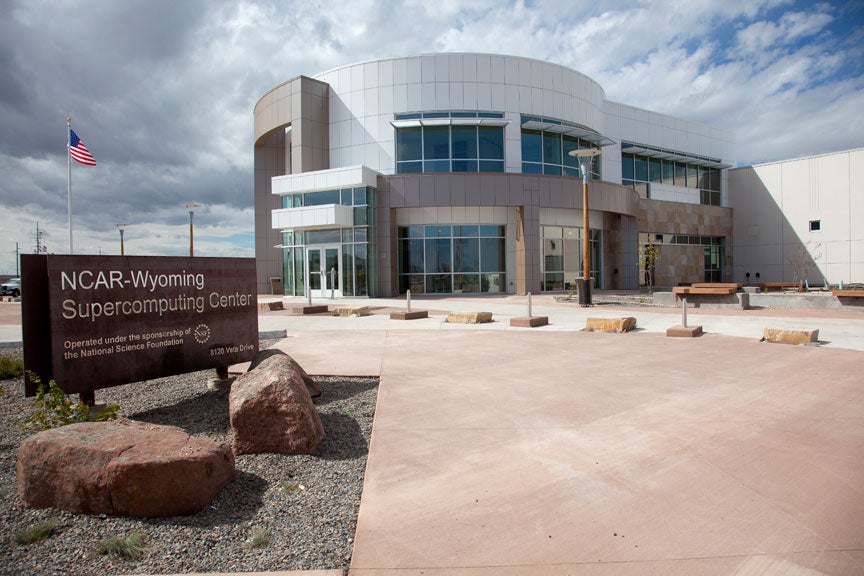
The building housing the NCAR-Wyoming Supercomputing Center in Cheyenne, Wyoming, was completed in the summer of 2011. (©UCAR. Photo by Carlye Calvin. )
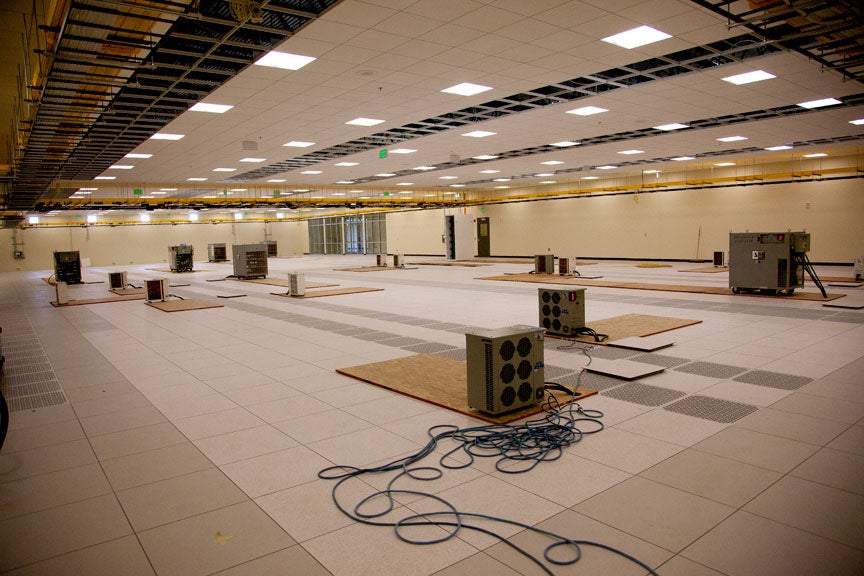
Inside the NCAR-Wyoming Supercomputing Center, a 12,000-square-foot computer room stands ready to receive its first components, which will occupy about one-third of the space. The small, temporary "loadbanks" shown here have been used to test the room's readyness to handle electrical and heat loads and will be removed when the new IBM system arrives. (©UCAR. Photo by Carlye Calvin.)
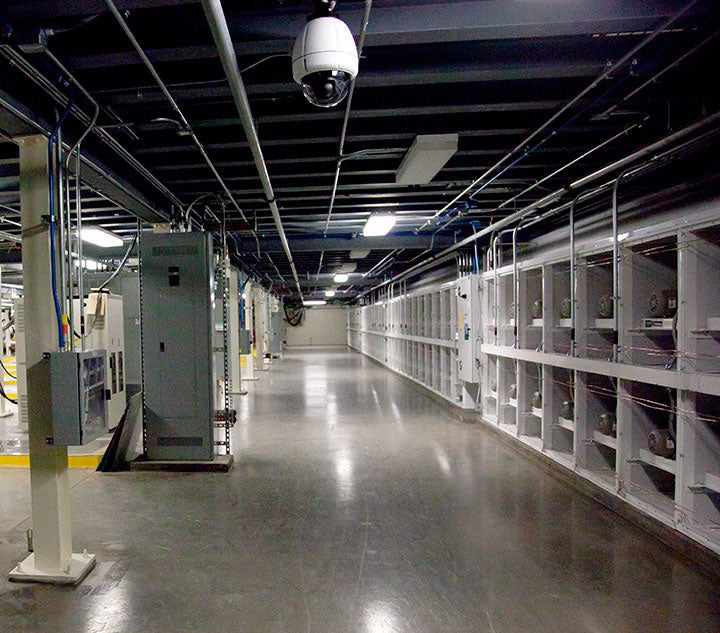
Beneath the floor of the supercomputing rooms lies a vast, 10-foot high utility space, the key to the facility’s flexible, energy efficient design. The electrical supply and cooling systems, including the fans at right in this photo, can be positioned and controlled for optimal energy use, and air can be circulated as needed to computing systems and servers. (©UCAR. Photo by Carlye Calvin.)

An artist's depiction of the NCAR-Wyoming Supercomputing Center. The center will be designed with the highest level of efficiency possible, both for the electrical and mechanical facilities and for the office spaces and multi-use areas. (Image courtesy H+L Architecture.)

Site plan for the NCAR-Wyoming Supercomputing Center. (Image courtesy H+L Architecture.)

Sunspot visualization. The interface between a sunspot's umbra (dark center) and penumbra (lighter outer region) shows a complex structure with narrow, almost horizontal (lighter to white) filaments embedded in a background having a more vertical (darker to black) magnetic field. Farther out, extended patches of horizontal field dominate. In a first, NCAR scientists and colleagues modeled this complex structure in a comprehensive 3D computer simulation, giving scientists an unprecedented glimpse below the visible surface to understand a sunspot's underlying physical processes. more about this study > (©UCAR, image courtesy Matthias Rempel, NCAR.)

Earth’s climate system. This image depicts a single month from a simulation of the 20th century by the NCAR-based Community Climate System Model, [version 4]. The CCSM is one of the world’s most powerful computer models for simulating the complex interactions of Earth’s climate system, including the atmosphere, oceans, sea ice, and land surface. This image captures wind directions, ocean surface temperatures, and sea ice concentrations. (©UCAR, image courtesy Gary Strand, NCAR.)


The workings of a supercomputer. Increasingly fast supercomputers are vital to research in a broad range of disciplines including weather, climate, oceanography, and air pollution. (©UCAR, photos by Carlye Calvin.)

Hurricane Katrina. Scientists used a high-resolution computer model, WRF-ARW, to simulate the forecast track and intensity of Katrina on August 27, 2005. Supercomputers have the computational power needed to create such fine-scale depictions, making them vital tools for helping scientists better understand hurricanes and other severe storms. Click here or on the image to launch the animation in a new window. (©UCAR)

Solar storms. Solar magnetic eruptions may cause the ejection of magnetized gas into interplanetary space. These events, known as coronal mass ejections, may generate interplanetary disturbances involving shock waves and magnetic clouds. If these disturbances encounter the Earth's magnetic field they can cause geomagnetic storms (visible as polar auroras). These storms pose danger to astronauts and, in severe cases, can damage technological systems society depends on, such as satellites, communications and navigation systems, and power transmission lines. more about this study > (©UCAR, visualization by John Clyne, NCAR.)