
New research takes first step toward advance warnings of space weather
Joint NSF NCAR-SwRI tool integrates global solar active region observations with a physical model and AI
Feb 23, 2026 - by Audrey Merket
Feb 23, 2026 - by Audrey Merket
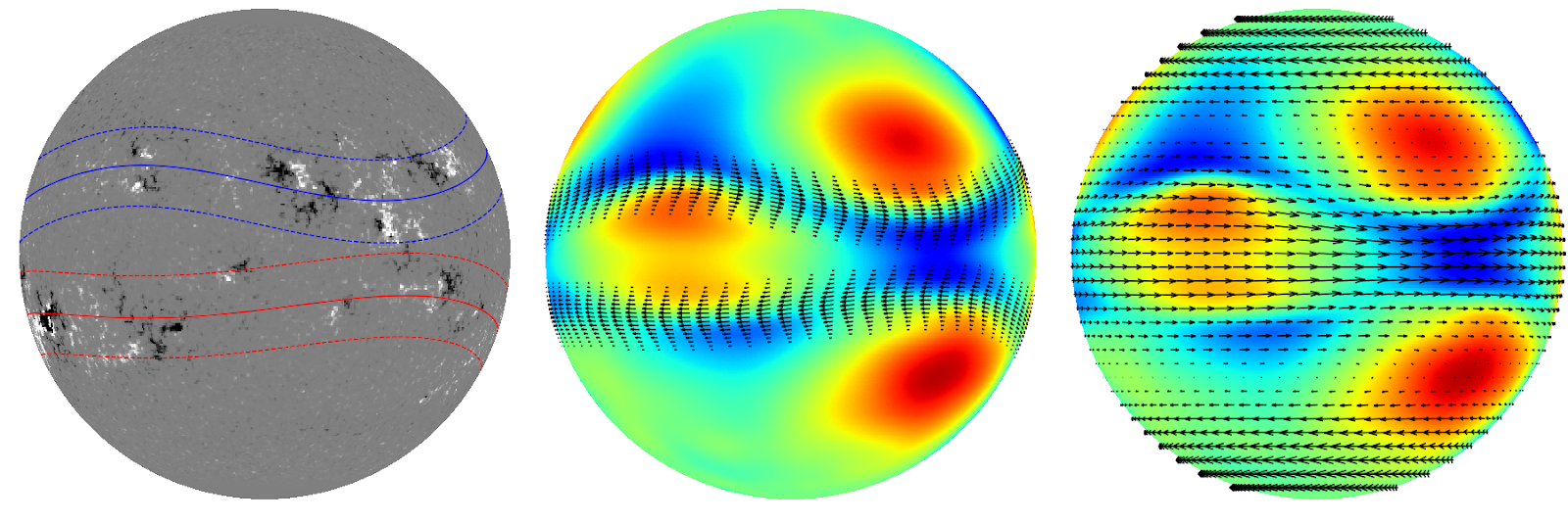
Joint research by Southwest Research Institute and NSF-NCAR developed PINNBARDS — a physics-informed neural network that connects surface observations of solar active regions to the deep magnetic dynamics of the Sun. The left figure shows solar observations of two warped toroid patterns (derived from SDO/HMI magnetograms) in the southern and northern hemispheres. PINN-derived results (center) show magnetic vectors (black arrows) overlaid on bulges (red) and depressions (blue) match with observed toroidal bands. The velocity field is marked with black arrows in the right image. These results provide clues about the global sources of active regions that produce space weather, which can impact our technical society.
| Impact Statement: The AI-enabled forecasting tool is a first step toward forecasting space weather weeks in advance, instead of just hours. This advance warning could allow agencies and industries to mitigate impacts to GPS, power grids, astronaut safety and more. |
Researchers at the U.S. National Science Foundation National Center for Atmospheric Research (NSF NCAR) and Southwest Research Institute (SwRI) have developed a new tool providing a first step toward the ability to forecast space weather weeks in advance, instead of just hours. This advance warning could allow agencies and industries to mitigate impacts to GPS, power grids, astronaut safety and more.
The research team’s newly published research highlights a tool they developed called PINNBARDS (PINN-Based Active Regions Distribution Simulator), which bridges surface observations of solar active regions and deep solar magnetic dynamics. The PINNBARDS framework is advancing a new generation of physics-informed, AI-enabled forecasting tools to better understand and anticipate extreme space weather. PINNBARDS offers the potential for substantially longer forecast lead times, which is critical for safeguarding satellites, communications infrastructure and future human space exploration.
“The reconstructed subsurface states from PINNBARDS provide initial conditions for forward simulations of solar magnetic evolution, opening the door to predicting where and when large, flare-producing active regions are likely to emerge weeks in advance,” said Mausumi Dikpati, NSF NCAR senior scientist, who led the team and co-authored the paper.
The simulations for the research – including code development, testing, and production runs – utilized the Derecho supercomputer at the NSF NCAR-Wyoming Supercomputer Center. The research was funded by NASA’s Heliophysics Guest Investigator Open (HGIO) program and Consequences of Fields and Flows in the Interior and Exterior of the Sun (COFFIES) DRIVE Center, a NASA-funded initiative where Dikpati is a co-investigator.
"One of COFFIES aims is to predict where and when the Sun will produce its next big, flare-generating active region,” said Todd Hoeksema, Stanford University professor and the lead of the COFFIES DRIVE Center. “By combining physics-based modeling with AI, this work lets us peer beneath the Sun’s surface and reconstruct the magnetic conditions that give rise to those regions."
For more about the research, see the SwRI news release.