
United States must take steps to adapt to climate change, report says
Sep 29, 2010 - by Staff
Sep 29, 2010 - by Staff
WASHINGTON, D.C.—A group of scientists, policymakers, and regional leaders unveiled a new report today about national and regional preparations for adapting to a changing climate. The report, based on the National Climate Adaptation Summit, was presented to President Obama’s science and technology advisor, John Holdren, at the American Association for the Advancement of Science (AAAS) in Washington, D.C.
The report concludes that the United States must adapt to a changing climate now and prepare for increasing impacts on urban infrastructure, food, water, human health, and ecosystems in the coming decades. It urges local, regional, and federal decision makers to develop and coordinate climate change adaptation measures across these scales of government and with the private sector. Measures that increase resilience to climate change can include changes in technology, management practices, or institutions.
The report also states that proactive adaptation planning can help minimize negative impacts of climate change on our nation’s communities, businesses, ecosystems, and citizens. The federal government must help set priorities and share information about relevant programs and best practices, according to the report.
The National Climate Adaptation Summit was convened by the University Corporation for Atmospheric Research in May 2010 as a result of a conversation between Holdren and the UCAR Board of Trustees.
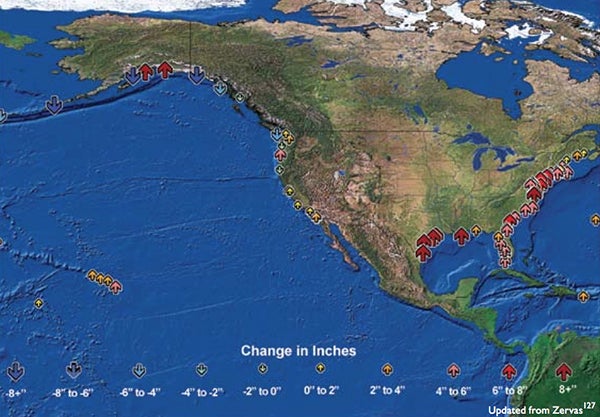
Relative sea level changes on U.S. coastlines, 1958 to 2008. These observed changes, measured over the last 50 years, show increases all along the Atlantic and Gulf coasts, including several areas with an increase of greater than 8 inches during that time. A smaller area of coast in the Pacific Northwest has decreased by a similar amount. Sea level is not uniform across the globe, and changes are also not uniform. (Image courtesy Global Climate Change Impacts in the United States, U.S. Global Change Research Program.)
The report identifies seven priorities for near-term action:
“The UCAR community has taken a close look at how our nation can become more resilient to climate change and what tools and workforce are needed to tackle these complex environmental, economic, and societal challenges,” says UCAR Vice President Jack Fellows. “The summit allowed us to broaden and deepen that conversation to include federal, regional, and local stakeholders.”
“Wise adaptation measures can protect our citizens, communities, and ecosystems from many negative consequences of climate change,” adds Rosina Bierbaum, dean of the University of Michigan School of Natural Resources and Environment and former UCAR board member. “But we need to act now. Some local adaptation efforts are more advanced than federal efforts. Thus, we all need to learn from one another, agree to a national strategy, and share and develop authoritative tools, information, and best practices.”
“I thank both UCAR and the summit participants for sharing their expertise and insights in this report,” Dr. Holdren says. “It is most timely and will be very helpful as our federal agencies draft a new 10-year Research Plan for Global Change and begin the next National Climate Assessment, both of which will give new emphasis to adaptation measures.”
Today’s presentation at the AAAS included comments from a panel of stakeholders who attended the May summit. They spoke about their local climate adaptation efforts and how the report’s findings will help them move forward. The panelists included:
About the report
Summit page for downloading a PDF of the report
Summit page for webcast viewing