
“The parting of the waters can be understood through fluid dynamics.”
Nov 2, 2010 - by Staff
Nov 2, 2010 - by Staff

Carl Drews (NCAR)
Carl Drews (NCAR) on research he conducted for his master’s thesis that recently appeared in the online journal PLoS ONE. Computer simulations run by Drews illustrate the movement of wind as described in the book of Exodus could have parted the Red Sea.
Drews showed that a strong east wind blowing overnight (see diagram) could have pushed water back at a bend where an ancient river is believed to have merged with a coastal lagoon along the Mediterranean Sea. A land bridge would have opened at the bend, enabling people to walk across exposed mud flats to safety. As soon as the wind died down, the waters would have rushed back in.
The study is part of a larger research project by Drews into the impacts of winds on water depths, including the extent to which Pacific Ocean typhoons can drive storm surges. For more details and an animation, see the NCAR news release from 21 September.
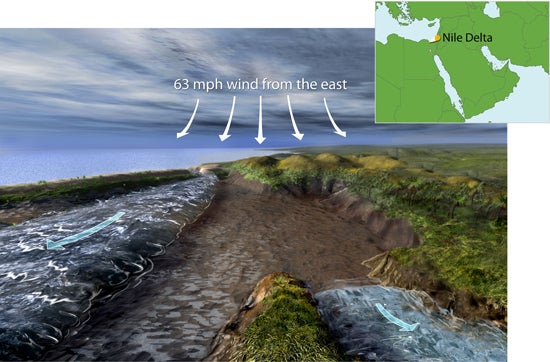
This illustration shows how a strong wind from the east could push back waters from two ancient basins--a lagoon (left) and a river (right)--to create a temporary land bridge. New research suggests that such a physical process could have led to a parting of waters similar to the description in the biblical account of the Red Sea. (Illustration by Nicolle Rager Fuller.)