
Climate history in 40,000 chapters
Mar 2, 2011 - by Staff
Mar 2, 2011 - by Staff
11 March 2011 • Elation was the mood of the day for participants in the West Antarctic Ice Sheet (WAIS) Divide project on 28 January. At 12:24 local time, a customized drill completed five years of work on the NSF-funded effort. Reaching a depth of 3,331 meters (10,928 feet), it retrieved the world’s second-longest ice core.
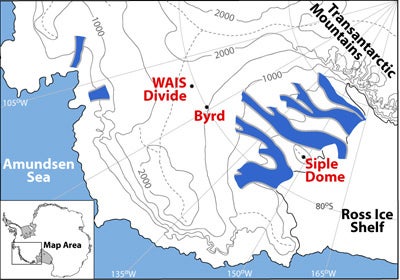
The WAIS Divide drilling site sits near the high point of the West Antarctic Ice Sheet. [illustration courtesy waisdivide.unh.edu]
Packed into the ice is an unprecedented amount of year-by-year data. Because of the drilling site’s relatively snowy climate—it receives about 50 centimeters (20 inches) in a typical year—there’s enough ice to delineate annual layers going back at least 40,000 years, with additional data extending back another 60,000 years. Cores from Antarctica are especially valuable for carbon dioxide analysis, as similar cores from Greenland include much more dust, which alters CO2 concentrations within the ice.
“Our major goal is to understand how the factors that control atmospheric carbon dioxide naturally are related to changes in climate,” says Ed Brook (Oregon State University), one of dozens of university scientists on tap to work with the WAIS Divide data.
The new core spans a number of sharp climate jumps from the last ice age, notes Richard Alley (Pennsylvania State University). “Some of these did affect CO2, so getting high-resolution records should allow us to see how things behaved when the changes were closer in speed to what we’re causing.”

Rebecca Anderson (Desert Research Institute) examines an ice core drawn from the West Antarctic Ice Sheet Divide. [U.S. Antarctic Program.)