
Baghdad to Boulder
Feb 27, 2009 - by Staff
Feb 27, 2009 - by Staff
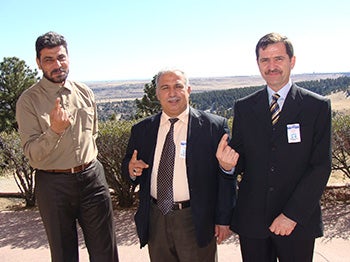
"I voted last week": Traces of purple ink were still visible on the
index fingers of Ali Sabeeh Dawood, Husam Hanna Habib, and Abdul Kareem Mohammad
(left to right) when they visited Rick Anthes at the Fleischmann Building
on 16 February.
February 27, 2009 | Many
atmospheric researchers are accustomed to collaborating with people
around the globe. But a recent U.S. visit by three scientists from
abroad carried more meaning than usual. It was the first delegation of
Iraqi scientists to visit the United States in decades.
Boulder’s NCAR and NOAA labs played host to Abdul Kareem
Mohammad, Husam Hanna Habib, and Ali Sabeeh Dawood on February 16–20.
All three are part of the Space Observatory and Simulation Research
Center, where Abdul is head, Husam is co-head, and Ali is a physicist.
The center is based in Iraq’s Ministry of Science and Technology, which
was established in 2003. “We want to make the reconstruction of our
country by education and by science,” Abdul Kareem told the Boulder Daily Camera.
The
visit was coordinated by Randolph “Stick” Ware, visiting scientist at
MMM and chief scientist of the Boulder firm Radiometrics. It emerged
from a routine request placed last year by the Iraqi Meteorological
Organization to purchase a radiometer from Ware’s company. Normally,
staff from Radiometrics would travel to the purchaser’s location to
install the equipment and train users, but the Baghdad location proved
problematic. “Then we set up training in Jordan, but for some reason
that fell apart, so the Iraqis said they’d try to come to our lab,”
Stick said. After a months-long wait, the scientists were granted U.S.
visas in late January.
Along with their visit to
Radiometrics, group members spent a full day at NOAA’s Earth Systems
Research Laboratory and several mornings and afternoons meeting with
NCAR scientists and touring the Mesa Laboratory. The group also paid a
visit to the floor of the Colorado State Senate on February 25. The
scientists’ strongest interests included GPS-based atmospheric
observations and weather modification.
“I am very happy here,” Abdul Kareem told Staff Notes. “I find all the scientists are very generous in helping us out.”
Stick
was moved by the purple ink still visible on the index fingers of the
visitors, who had voted in Iraqi elections only a week beforehand. “The
three purple fingers—that’s a sign of democracy. It was a really
compelling image,” says Stick.

Watch the
Iraqi scientists at a meeting on February 20 with Stick Ware and ESSL/HAO
staff, including HAO director Michael Knolker. Or download the high-resolution
version.
MMM’s
Syed Rafat Husain Rizvi, a former meteorologist with the Indian
Meteorological Department, hosted the group for a Saturday-night dinner
on February 21. Rizvi encouraged the group to consider exploring the
Weather Research and Forecasting model and its data-assimilation
version. “I was delighted to hear their views about rebuilding Iraq,”
says Rizvi. He adds that the U.S. visit will provide valuable input for
the Iraqi Ministry of Science as they explore possibilities for future
U.S.–Iraqi scientific collaboration.
“The Iraqi scientists had a very good sense of
humor,” says Rizvi. As it turns out, Rizvi and his wife have the same
color of couch and carpet as Abdul Kareem, who told Rizvi, “I feel
absolutely relaxed. Looks like I am in my own home.” Rizvi says that
his wife “carefully chose the menu to suit the Iraqi taste,” including
such dishes as malai kofta with chapati, kabab, chicken mughlai
biryani, kheer, and darjeeling tea. “I am sure they enjoyed the dinner
as we enjoyed their company.”