
From garbage to garden: Staff tour compost facility
Feb 10, 2009 - by Staff
Feb 10, 2009 - by Staff
February 10, 2009 | Ever wonder what happens
to those orange rinds, coffee grounds, and napkins you toss in the compost
bin at work? In January, about a half dozen staff found out during a visit
to A1 Organics in Platteville. The
company has been in the organic recycling business since 1974.
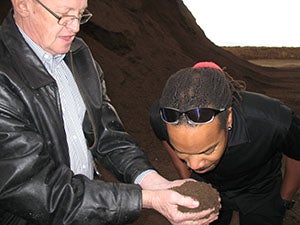 Tim Barnes smells the finished product. (Photos by Nicole Gordon.)
When organic compost leaves UCAR’s cafeterias, kitchens, and coffee stops,
its first stop is Eco-Cycle in Boulder. It is then trucked to A1’s Platteville
facility, northeast of Longmont. It begins its transformation from smelly garbage
to rich gardening soil through the natural process of composting, during which
microorganisms and chemical reactions break down organic material. The process
generates heat as decomposition takes place, killing pathogens.
“Compost collection is one of the most popular conservation programs we have
here at UCAR,” says Kimberly Kosmenko, UCAR’s sustainability coordinator. “Last
year we sent more than 31,000 pounds of compostables to A1. That means we’re
reducing the waste and greenhouse gas emissions associated with sending food
scraps to landfills, and we’re supporting our local economy by turning our
waste into a valuable commodity.”
At A1, the UCAR group walked among 70 acres of windrows (tall, long rows)
of compost, some of which were steaming even in January. A typical windrow
takes about 90–120 days to fully compost. A1 staff insert probes into the piles
to ensure that temperatures reach at least 135ºF (55ºC), the minimum for destroying
pathogens. After a pile is fully composted, oversized items are sifted out
before the final product is shipped to garden centers and the landscaping industry.
Last year, A1 composted 1.1 million cubic yards of raw material, which amounted
to 300,000 cubic yards of finished product—about the volume of a 20-story skyscraper
that covers a quarter of a city block.
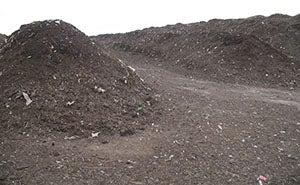 Windrows cover the Platteville site.
From an environmental perspective, composting organic material is preferable
to dumping it in a landfill. Landfills are rich in moisture and nutrients,
but their waste is exposed to very little oxygen, which means that organic
materials break down by anaerobic decomposition. One of the main byproducts
of anaerobic decomposition is a potent greenhouse gas, methane. When organic
materials are composted, carbon dioxide—another greenhouse gas—is released.
However, the finished compost creates a carbon sink that absorbs more of the
gas than was released during decomposition, such that the Environmental Protection
Agency has concluded that organic composting does not contribute carbon emissions.
A1 staff stressed the importance of keeping the stream of compost coming to
the facility free of contamination. When plastic, metal, and other non-compostable
items are found in the stream in great enough numbers, the compost must be
taken to a landfill instead.
A simple test for determining if an item is compostable is to ask the question:
“Was it once alive?” (The answer should be yes.) Even so, staff were surprised
to see some of the things that end up in A1’s piles—in particular, beer and
money. The company composts leftover beer for Coors Brewing Company, as well
as torn, unusable money taken in by banks.
The trip was arranged by Sustainable
UCAR. On February 19, Sustainable UCAR will host a workshop on backyard
composting. Master composter Melanie Burow will cover everything from how
to start a home compost pile to composting with worms.