
Bus, shuttle, bike, dial in
Staff take advantage of work and transport options
Dec 10, 2008 - by Staff
Dec 10, 2008 - by Staff
December 10, 2008 | It’s an insecure world
out there, with financial meltdowns and rising fuel and food prices—not to
mention a warming climate. If there’s a bike in the back of your garage collecting
dust, this might be the time to dust it off and burn calories instead of crude.
Never used your Eco Pass? Hint: it’s that little sticker on your employee ID
card. Just show it to the bus driver when you board.
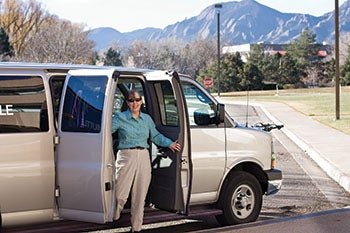 Sherrie Fredrick lives in Louisville but manages to leave her car at home
three days
a week.
“UCAR has many policies and benefits to assist our employees,” says Bob Roesch,
director of HR. Some of these are well known, such as the RTD Eco Pass that
every staff member receives, the UCAR shuttle system, the Blue Bike fleet,
and the UCAR Child Care Center with its convenient location near Center Green
and Foothills. There are also showers, locker rooms, and bike racks and covers
at each campus. And with onsite cafeterias at most sites, there’s no need to
drive into town for lunch.
In addition, UCAR’s Work and Family Policy 6-12 includes arrangements such
as flextime, Flexiplace, and compressed work weeks. (For more information,
see recent Delphi questions on this topic.) Bob points out, however, that UCAR
is a 24/7 operation. Staff can negotiate alternative work arrangements with
their supervisors if their jobs are compatible with flexible schedules, and
supervisors are encouraged to be flexible. “The key phrase here is ‘if their
jobs are compatible,’” he says. “Staff can discuss their individual situations
with HR representatives, but the bottom line is that we have obligations to
our funders and customers.”
Staff Notes asked around to see how people are taking advantage of UCAR’s benefits
and policies to make getting to and from work more affordable—and often more
pleasant as well.
Sherrie Fredrick, software engineer, ESSL/MMM
Sherrie lives in Louisville but manages to leave her car at home three days
a week. “I really don’t like driving,” she says.
She takes the Dash bus into Boulder to Table Mesa Park-n-Ride, where she catches
the UCAR shuttle to Foothills Lab. The commute takes about 45 minutes. “I usually
just close my eyes and relax,” she says. “Or sometimes I put my bike on the
bus and then ride from Table Mesa to Foothills, which takes about half an hour.”
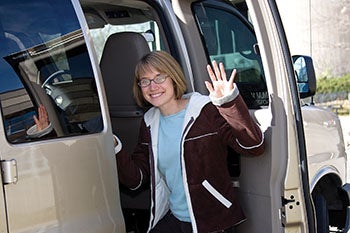 Lisa Gardiner’s work arrangement combines telecommuting from Denver
with public transportation and the UCAR shuttle.
Lisa Gardiner, educational designer, EO
Lisa lives just south of City Park in Denver. She telecommutes two to three
days per week. “A lot of my work is on the Windows to the Universe website
and other educational sites, which is the sort of thing that can be done from
anywhere,” she says.
On these days, Lisa’s highly efficient “commute” involves walking into her
home office and turning on the computer. By dialing in through VPN, she can
access all the files on her computer at Center Green.
She commutes to Boulder the other two or three days of the week, taking the
Boulder Express from Market Street Station to Table Mesa Park-n-Ride, where
she either catches the UCAR shuttle or bikes to Center Green. “It’s a long
commute because I have to get to Market Street and then from Table Mesa to
UCAR,” she says. “But it’s kind of nice because I read, listen to books on
my iPod, or chat with friends on the bus.”
Lisa says that her Eco Pass saves her $8 for every trip to Boulder, since the
normal fare is $4 each way. However, she’s been telecommuting and taking the
bus for six years, long before gas prices shot up. “Of course, saving money
is always nice, but that’s not my primary motivation,” she says. “It’s better
for the environment—I’m saving greenhouse gases by taking the bus.”
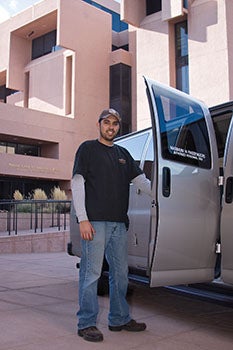 Armando Cisneros catches the UCAR shuttle at
the Mesa Lab.
Armando Cisneros, network technician, CISL
Armando used to drive to work every day. This past summer, higher gas prices
(along with a new car that used more gas) convinced him to string together
a commute using RTD and the UCAR shuttle. The result? He estimates he’s saving
about $490 a month.
Armando leaves his Arvada home at 6:00 a.m. to catch a local bus to Highway
93, where he transfers to the GS bus that runs from Golden to Boulder. He gets
off at Table Mesa and Broadway and boards
the UCAR shuttle at King Soopers for his final leg up to the Mesa Lab. He’s
walking into his office about 7:00 a.m.
“It’s really relaxing in the mornings because you have time to sit back and
read or do whatever you want to do,” he says. “The only problem I have is that
on my way home, there’s a 15-minute layover between each bus, so I’m waiting
a lot and I just want to get home at night. But the money saved is obviously
a big plus.”
Aimé Fournier, scientist, CISL
Aimé lives up the hill—Nederland, that is. He’s been commuting to Boulder for
more than ten years, using a combination of bus, shuttle, bike, and foot. “I
find it rewarding for the exercise,” he says.
Aimé’s day starts with taking the Nederland bus down the canyon to the Boulder
Transit Station at 14th and Walnut. If he’s headed to Center Green for the
day, he generally rides his bike there, bringing the trip to about an hour.
He also has the option of taking the 208 bus to Valmont and then walking a
bit, or walking from downtown to the Twenty Ninth Street mall and catching
the UCAR shuttle. If he needs to be at the Mesa Lab, he takes the Skip and
shuttle. “The timing of the bus service is not great, but the coverage is good,”
Aimé says.
On snowy days, Aimé often telecommutes from Nederland rather than descending
the canyon. He says he’d like to see UCAR/NCAR build a stronger telecommuting
culture by taking advantage of webcasting and collaborative technologies.
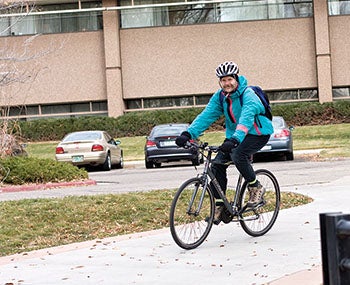 Frank Flocke bikes to Foothills Lab nearly every day.
Frank Flocke, scientist, ESSL/ACD
Frank lives near Baseline and Foothills. He bikes to Foothills Lab nearly every
day, partly because he and his wife share one car and partly because he enjoys
the exercise. “I do it because it’s good for me and because it saves us money,
since if we both drove, we would need two cars,” he says, adding that “when
the car is gone in the morning, you can’t take it.”
Fortunately, the Foothills bike path runs right by Frank’s house. “I’m very
lucky that, other than the light at Pearl Street, I don’t have to cross any
roads at all,” he says. The bike path even has an overpass that makes getting
from the west to east sides of Foothills a snap. The ride takes about 15 minutes,
and he’s able to transport his laptop in a backpack.
“The times I don’t ride is when it’s icy,” Frank says. “But Boulder has such
nice weather in general—it’s a little cold sometimes but it’s not miserable.”
If the weather is unusually bad, Frank has the option of leaving his bike at
work and getting home via a combination of shuttle and bus.
In addition to the exercise he gets, Frank sees another perk in taking the
Foothills bike path to work. “I enjoy looking at the prairie dogs—they’re cute.”