
Aloha spirit: Eric Yasukawa’s long, high career
Dec 11, 2008 - by Staff
Dec 11, 2008 - by Staff
December 11, 2008 | Staff working at the
Mesa Lab might think they’re above it all—literally, that is—when they look
down on Boulder from their stone towers in the Flatirons. But the NCAR award
for putting in time at high elevation goes to Eric Yasukawa (ESSL/HAO), who’s
been working at 11,250 feet (3,440 meters) for the past 36 years.
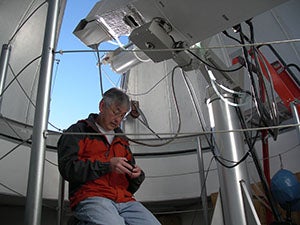 A
A
typical day for Eric includes everything from monitoring computer output
to fixing instrumentation. (Photos by Rich Summers/HAO.)
Eric and two colleagues are stationed at HAO’s Mauna
Loa Solar Observatory,
located on the Big Island of Hawaii. The facility is situated in barren lava
fields on the northern flank of the 13,679-foot (4,169-meter) volcano, far
above the tropical foliage for which Hawaii is better known.
Eric says that his office window has one of the best views in the world: “We
can see Mauna Kea, both coasts of the Big Island, and Maui.”
Mauna Loa and neighboring peak Mauna Kea are some of the best places in the
world for astronomical observing. The Big Island’s distance from urban lights
ensures dark skies, while the thin, dry air and stable atmosphere are ideal
for viewing the solar system and running instruments. Scientists in HAO use
data from the observatory to study the Sun’s atmosphere (see sidebar).
Eric is the station manager of a three-person staff that includes Darryl Koon
and Allen Stueben. “We operate 363 days a year from sunrise to sunset,” Eric
says. “The air’s a little thinner but otherwise we have a normal workday.”
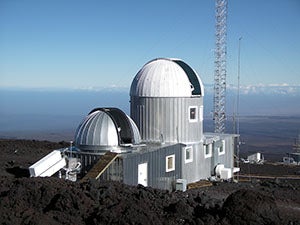 The Mauna Loa Solar Observatory sits in lava fields on the volcano’s
northern flank at 11,250 feet (3,440 meters).
For the most part, this means sitting in front of a computer monitoring activity
and making sure that instruments are running correctly. However, the team does
everything from taking out trash and sweeping floors to fixing instrumentation,
doing upgrades, and reporting problems.
Rich Summers, who manages instrumentation for HAO, credits Eric for much of
the observatory’s success. “Eric’s an inspiration,” says Rich, who describes
Eric as having a quiet dedication and strong work ethic. “He’s been a real
leader.”
Eric may claim that his job consists of simply a normal workday in thinner
air, but in fact it has the potential to be far more exciting than a typical
day at HAO’s Center Green offices. Mauna Loa is the largest volcano on Earth
and one of the most active.
“We’ve had a couple of eruptions up here,” Eric recalls nonchalantly. One eruption
in 1975 sent lava flows within 25 yards of the observatory’s road, and another
in 1984 cut the power lines. “We were running a generator for six months while
we waited for the lava to cool so the power company could put poles back in
the ground,” Eric says.
In 1975, an earthquake that measured 7.2 on the Richter scale rocked the observatory.
“We could see the parking lot waving like somebody was shaking it, and the
cars were rolling around,” Eric remembers.
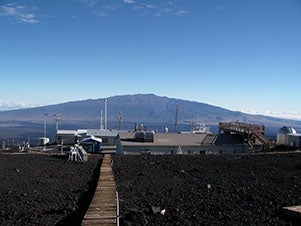 The view of Mauna Kea from the back door of the observatory.
Mauna Loa is due for an eruption, but Eric probably won’t be around for it,
since he plans to retire in January. He’s witnessed a lot of changes since
he started working at the observatory in 1972. Back then, staff transmitted
data back to HAO via good old-fashioned paper charts. “Then we moved to magnetic
tape, and now the Internet,” Eric says.
Charlie Garcia and Dick Hanson were operating the observatory when Eric was
first hired on as a casual worker. He’d just moved back to Hawaii after finishing
a degree in environmental biology at CU-Boulder. “I started out painting boardwalks
and doing odd jobs while looking over Charlie’s shoulder, and just picked it
up,” Eric says. He gradually took on more duties at the observatory, becoming
an expert.
“Eric has been involved with the testing, installation, and operation of at
least eight different instruments at the observatory,” says Joan Burkepile,
who manages the observatory’s data operations. “He’s incredibly knowledgeable.”
One of the highlights of Eric’s tenure, in addition to eruptions and earthquakes,
was meeting UCAR founder Walt Roberts in 1986. Halley’s Comet was making a
pass toward Earth at the time, which drew Walt to Hawaii to observe the event.
“It was totally rained out, so we spent the evening at a restaurant eating
shrimp,” Eric remembers. “Walt was a very interesting person.” (Walt himself
worked above 10,000 feet for seven years in the 1940s at the Climax Observatory
in Colorado.)
Eric’s favorite part of his job has been working with his crew and interacting
with staff back in Boulder. “Working with instrumentation is interesting, of
course, but the people are the best part,” he says. “Even though we often work
solo at the observatory, it takes a community to successfully do our job.”
 A series of images from the MK4 K-Coronameter atop Mauna Loa shows a coronal mass ejection that took place on February 22, 2004.