
Thomas Bogdan named next president of UCAR
Will take the helm in January
Oct 18, 2011 - by Staff
Oct 18, 2011 - by Staff
18 October 2011 • After an international search, the UCAR Board of Trustees has named Thomas J. Bogdan to succeed Richard Anthes as UCAR president. His new role begins on January 9, 2012. Bogdan, who has led NOAA's Space Weather Prediction Center for over six years, has a rich history with NCAR, UCAR, and NSF.
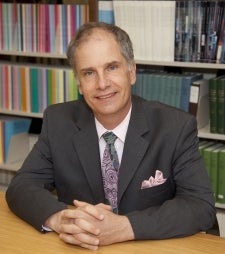
Tom Bogdan (©UCAR.)
“Tom Bogdan is an excellent scientist, an experienced manager, and an effective communicator and advocate for science both nationally and internationally,” says Dennis Hartmann of the University of Washington, chair of the UCAR Board of Trustees. “We are very excited that he will be leading UCAR into the future.”
“I am delighted with this choice,” Anthes says. “I have known Tom for many years as a superb scientist and leader, a thoughtful and considerate person, and a man of highest integrity. I have great confidence that he will provide UCAR with distinguished leadership.”
For more details on the announcement, see the UCAR news release issued on 18 October and the letter from Dennis Hartmann, below.
Bogdan's interest in the history of NCAR's High Altitude Observatory is chronicled in a 2000 Staff Notes article, The archaeologist of HAO . He describes his stint in Washington in a 2005 feature, Rotating scientists recall time at NSF.
Dear Colleagues,
It is with great pleasure that we announce the appointment of Thomas J. Bogdan to be the next President of UCAR. Tom’s career includes a breadth of experience with many aspects of the UCAR community and our partners in government and industry. Tom has worked at UCAR as a senior scientist and a senior manager at NCAR, as well as with NCAR’s primary sponsor, the National Science Foundation. At NSF he served as Program Director for the Solar-Terrestrial Research Section of the Atmospheric and Geospace Sciences Division from 2001 to 2003. He has extensive experience in working with a wide variety of federal stakeholders, and in developing international and commercial partnerships not only in basic research, but also in operational prediction. Tom is an inspiring public speaker and an excellent advocate for the role of science in the larger community. He is also an adept administrator experienced in the formulation and execution of plans, budgets, and priorities. He is deeply committed to UCAR’s mission, is visionary about its future, and will be an effective advocate and eloquent spokesperson for UCAR, its member communities, and its many diverse programs.
Tom comes to UCAR from the National Oceanic and Atmospheric Administration, where he is currently the Director of the Space Weather Prediction Center. He will assume the presidency of UCAR on January 9, 2012, succeeding Rick Anthes, who has served UCAR with distinction as president for the past 23 years. Rick will continue to support UCAR and NCAR in a variety of special projects.
Many of you will know Tom from his years at NCAR and UCAR, where his research focused on solar magnetic activity and variability. Tom came to NCAR as a postdoc in 1983 and was promoted to Senior Scientist in 1993. He was a founding member of the NCAR Senior Scientist Assembly and then served two years as the Science Liaison to the NCAR Director. He served as the Acting Director of the Advanced Study Program and then as the Founding/Acting Director of the Laboratory for Societal-Environmental Research and Education (SERE). He also served as the NCAR representative to the UCAR COMET Program Advisory Board.
While at NCAR Tom was encouraged to spend two years on an Inter-Agency Personnel Agreement with the Atmospheric Sciences Division at the National Science Foundation in Arlington, Virginia, where he was the first NCAR scientist to work side-by-side at the foundation with the NSF Program Managers. During this time he was instrumental in developing NSF’s first bridged faculty program in the space sciences, which resulted in the creation of eight new tenure track faculty lines devoted to solar-terrestrial research and education at U.S. universities.
In May of 2006, Tom left NCAR to tackle the challenge of leading America’s civil operational space weather program, serving as the Director of one of only four U.S. Department of Homeland Security National Critical Systems within the National Weather Service. The Space Weather Prediction Center is the source for 24x7 space weather alerts, watches, warnings, and guidance to customers in 122 countries around the globe. As its Director, he represents the space weather enterprise across every affected sector of government and society, working with federal and commercial stakeholders to create the partnerships necessary for success. With the rapidly growing international awareness of the global impact of space weather, Tom has developed working relationships with space weather practitioners and users from the European Commission, Canada, South Korea, and the United Kingdom under the aegis of the World Meteorological Organization; the International Civil Aviation Organization; and the UN Committee on the Peaceful Uses of Outer Space. He has negotiated bilateral Memoranda of Understanding and Service Level Agreements with the assistance and approval of the State Department and the National Security Staff, giving him a rich set of international experiences that add to his core competencies as incoming UCAR President. In his role as Director of the Space Weather Prediction Center, Tom has been a very effective communicator in raising awareness and appreciation for the impacts of extreme space weather at the highest levels of government and industry, and he has gained the resources to better enable space weather prediction and warnings. We are confident that Tom will translate the leadership, management, communication, and advocacy skills he has demonstrated at NOAA to UCAR, NCAR, and UCAR’s Community Programs.
Tom is currently a member of the Council of the American Meteorological Society and works closely with the World Meteorological Organization as the U.S. point-of-contact for space weather issues. He has been honored as a fellow of the AMS. He serves on the Advisory Council for the College of Arts and Sciences of the University at Buffalo, the State University of New York, and as a co-chair of the National Space Weather Program’s Committee on Space Weather. He has chaired and served on numerous NSF, NASA, and National Research Council committees and panels that provide community-based advice to the federal agencies and policymakers.
Tom earned a doctorate in physics at the University of Chicago in 1984 and graduated Summa Cum Laude with a B.S. in mathematics/physics from the University at Buffalo in 1979. He is the author of over 100 papers in solar-terrestrial research, was the recipient of the Gregor Wentzel and Valentine Telegdi Prizes from the University of Chicago, and spent the summer of 1989 as a Visiting Gauss Professor at the Göttingen University Observatory in Germany.
I’m sure you will join us in welcoming Tom back to UCAR in his new capacity, leading a team that will allow UCAR and NCAR to continue their strong record of science achievement, facility development, and service to meet the challenges of the future.
Dennis Hartmann,
on behalf of the UCAR Board of Trustees