
Chasing subseasonal forecasts with AI
NSF NCAR researchers utilize emulators in pursuit of extended forecasting window
Jul 22, 2026 - by Audrey Merket
NSF NCAR Road lane closures Aug. 24-25 - Expect delays and no pedestrian or bicycle access
View more information.Jul 22, 2026 - by Audrey Merket
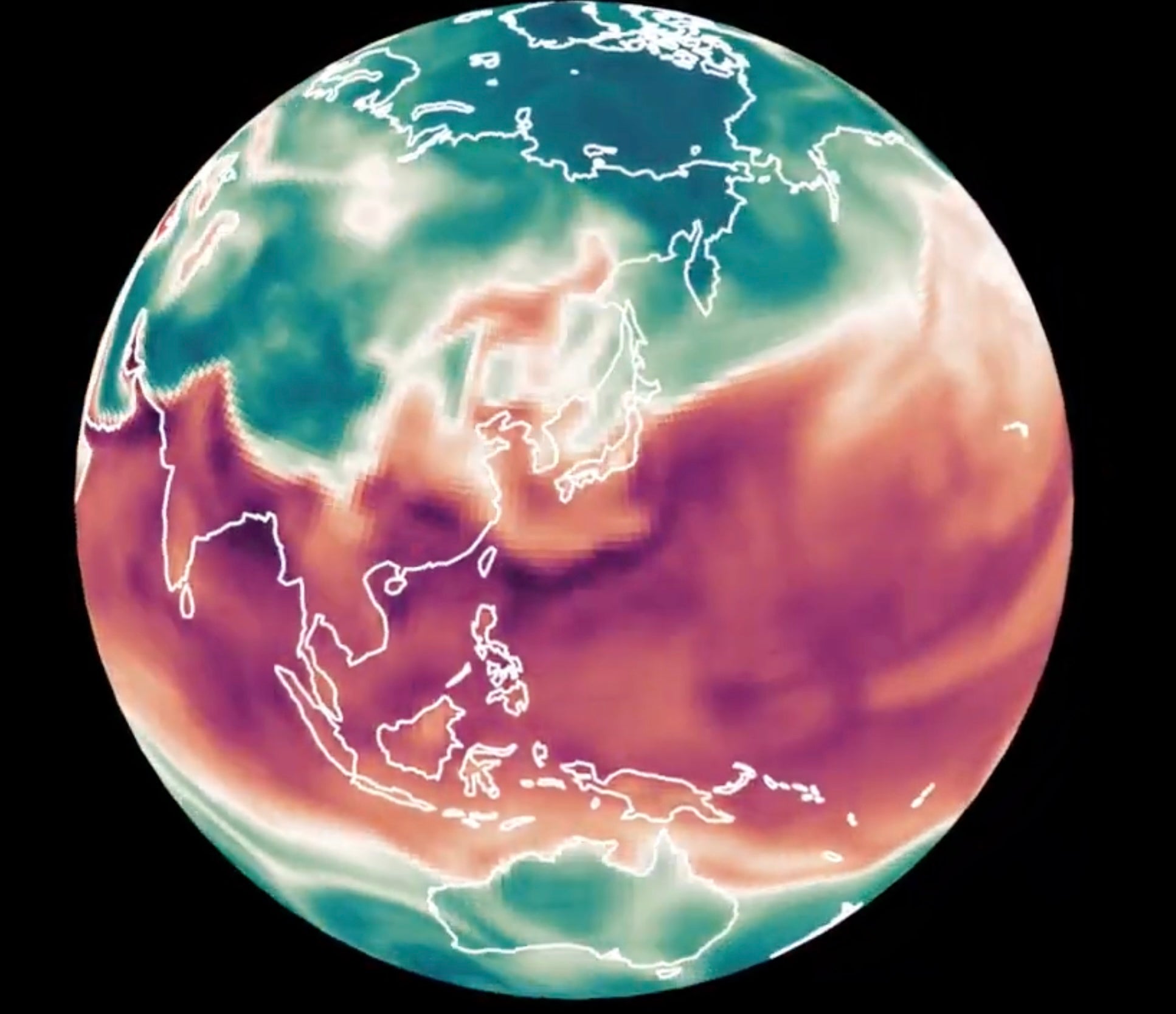
A CAMulator simulation captures global humidity at six hourly timesteps. (Visualization courtesy of Will Chapman/CU Boulder).
| Impact statement: AI has the potential to accelerate reliability in subseasonal forecasting, a capability that would strengthen the resilience and economic stability of many sectors including energy, water management, and agriculture. |
Subseasonal forecasting, or the ability to predict weather trends two weeks to two months in advance, is a capability highly sought after in various economic sectors, including energy, water management, and agriculture. Reliable forecasts on this scale have thus far been largely out of reach, but researchers at the U.S. National Science Foundation National Center for Atmospheric Research (NSF NCAR) are leveraging AI to see if it helps them grasp this elusive capability.
In this pursuit of subseasonal forecasting, NSF NCAR researchers are turning to AI emulators. Emulators are trained on existing simulation data produced by weather and Earth system models to recognize underlying patterns. Once they are trained, they can predict future outcomes at a fraction of the time and computational cost compared to running weeks-long simulations on supercomputers using traditional models.
NSF NCAR’s first emulator is called CAMulator and uses machine learning to recreate the NSF NCAR-based Community Atmosphere Model (CAM). CAMulator and other emulators in development at NSF NCAR offer the potential to accelerate our ability to predict whether the next month is likely to be hotter, colder, wetter, or drier than normal.
“Anything that enables us to better understand how to improve forecasting skill on subseasonal timescales would be really crucial for making important decisions in industries from agriculture to water management,” said Kirsten Mayer, an NSF NCAR scientist leading the research on subseasonal prediction with CAMulator. “Improving our understanding about sources of predictability for subseasonal forecasting is really important and emulators could play an important role in accelerating our understanding.”
The research is funded by the U.S. Department of Energy and NSF NCAR.
Capturing patterns
Accurate subseasonal forecasting requires understanding longer-term, global atmospheric patterns that are closely tied to the state of the ocean. This means the ability to produce these subseasonal forecasts hinges on a model being able to capture global atmospheric conditions and incorporate ocean conditions.
CAM is able to do both those things, but its traditional, physics-based architecture uses substantial computing time that restricts the number of simulations scientists can run, limiting rapid progress in improving subseasonal predictions. CAMulator solves this problem by imitating the model with a fraction of the computing resources.
CAMulator was trained on version six of CAM (CAM6), a computer model developed at NSF NCAR that is used by the weather and climate research community to simulate global atmospheric conditions. The emulator can generate 480 simulated years per day, which is approximately 350 times faster than CAM6.
The emulator is built on the Community Research Earth Digital Intelligence Twin (CREDIT), a research platform that allows users to train, run, and evaluate AI numerical weather prediction models.
CAMulator works by reacting to atmospheric initial conditions and prescribed sea surface temperatures. The emulator makes a six-hour forecast based on those initial conditions and then that forecast is put back into the emulator and used to generate the next six-hour forecast. This iterative process continues for as many days as the researchers want. However, small errors tend to snowball as they are fed back into the emulator, which decreases the accuracy as the timeframe gets further into the future – a universal forecasting problem.
Nevertheless, CAMulator has proven to be skilled at capturing large-scale and slower varying patterns including El Niño Southern Oscillation (ENSO), the Pacific–North American (PNA) pattern, and the North Atlantic Oscillation (NAO). These patterns are a proven source of predictability for subseasonal time scales.
Mayer describes subseasonal forecasting like trying to predict where a rubber duck will go in a bathtub with a splashing toddler – very chaotic and hard to predict. However, when large-scale signals like ENSO are identified, it is more like predicting where a rubber duck will go in a tub after turning on a faucet with strong water pressure. There is still some uncertainty, but known patterns of behavior make it much easier to predict where the rubber duck will go. Likewise, CAMulator’s ability to closely predict patterns associated with ENSO is promising for its ability to predict subseasonal forecasts.
Tools for the scientific community
Over the last year, Mayer and her colleagues have been testing CAMulator in an international competition called the AI Weather Quest where teams compete to provide the most accurate AI-based subseasonal forecasts. The research team is already planning how they will adjust CAMulator and future emulators based on the lessons they are learning from CAMulator’s performance and the success of other emulators in the competition.
NSF NCAR researchers are also developing an emulator based on the Community Earth System Model (CESM). Called subCESMulator, it has almost identical architecture to CAMulator, but it incorporates interactive land and ocean variables. Mayer hopes that those extra pieces of information will help improve the accuracy of NSF NCAR’s AI-based subseasonal predictions.
“These emulators are a great scientific tool that allow us to ask questions we weren’t able to ask before because of the compute resources that traditional models require,” Mayer said. “Because they require so much less compute power, CAMulator and subCESMulator should be able to run on a modern laptop. Allowing individual researchers to be able to run their own simulations without the need for a large supercomputer would really democratize access and accelerate discovery across the research community.”
Title: CAMulator: Fast Emulation of the Community Atmosphere Model
Authors: William E. Chapman, John S. Schreck, Yingkai Sha, David John Gagne II, Dhamma Kimpara, Laure Zanna, Kirsten J. Mayer, Judith Berner
Source: ArXiv