
Helping the national parks weather future storms
With billions of dollars at stake, scientists seek to improve resilience to future hazards
Jul 15, 2026 - by David Hosansky
NSF NCAR Road lane closures Aug. 24-25 - Expect delays and no pedestrian or bicycle access
View more information.Jul 15, 2026 - by David Hosansky
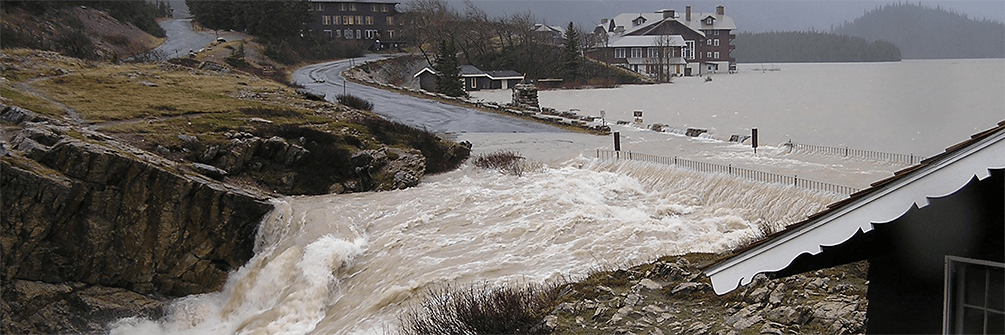
Damaging floods at Glacier National Park in November 2006. (Photo by U.S. Geological Survey.)
| Impact statement: Identifying future weather hazards at national parks can help guide plans for more resilient infrastructure. |
Since the creation of Yellowstone National Park in 1872, America’s national parks have become hugely popular destinations, revered for protecting iconic landscapes and historically significant sites. They’re also a potent economic engine, generating tens of billions of dollars in spending by visitors at gateway communities and supporting thousands of jobs.
But the parks are vulnerable to severe storms and other weather events that can produce flooding in steep terrain, wash away isolated roads, damage fragile historical structures, and cause other destruction. The damage can lead to long-term park closures, disappointing visitors and hurting local economies.
Now researchers at the U.S. National Science Foundation National Center for Atmospheric Research (NSF NCAR) are using global computer simulations of the Earth system to identify changes in future weather conditions that could affect the frequency and intensity of these disruptive storms.
The research team is focusing initially on Montana’s Glacier National Park. In 2006, heavy rains melted and dislodged snowpack from an early-season snowstorm, causing landslides on steep slopes and widespread river flooding. The flooding from this “rain-on-snow” event severely damaged popular facilities, requiring extensive reconstruction of the heavily visited Going-to-the-Sun Road as well as many park bridges and trails.
“We’re studying what would happen if the 2006 storm occurred in the future with different weather patterns, and how that would impact the park itself as well as gateway communities and surrounding areas,” said NSF NCAR scientist Kyle Nardi, who is leading the research. “One of the motivations is to inform the National Park Service about hardening park infrastructure to storms that can change in the future.”
The research team includes scientists at Lawrence Berkeley National Laboratory and Pennsylvania State University as well as NSF NCAR. Funding for the project comes from NSF.
Severe weather events frequently batter America’s national parks. Nardi’s interest in the topic stems in part from memories of recurrent flooding at Valley Forge National Historical Park in Pennsylvania, near his childhood home.
Damaging storms in recent decades include devastating floods at Yosemite National Park in 1997 that obliterated campgrounds, washed out bridges, and forced a months-long closure of the park. Catastrophic fires during extremely dry conditions at Yellowstone in 1988 affected more than one-third of the massive park. And the November 2006 storm system that flooded Glacier also unleashed torrential rains at Mount Rainier in Washington, creating such widespread damage that the national park closed for six months.
To better understand how such weather hazards may change over the next several decades, Nardi and his colleagues have turned to the NSF NCAR-based Community Earth System Model, a world-leading software tool that enables scientists to simulate Earth system processes worldwide. By developing a version of the model that can zoom in on a single area, such as Glacier, they can simultaneously recreate weather conditions in the park as well as the distant oceanic and atmospheric processes that influence those conditions. This approach enables them to anticipate how weather in the park will be affected in the future by changes elsewhere.
The researchers have successfully reproduced most aspects of the 2006 floods in Glacier. But they are still making fine-scale adjustments to the model to more accurately capture certain aspects of that event, such as the amount of melting snow that contributed to the floods.
Once those adjustments are made and Nardi is confident in the model’s ability to capture rain-on-snow events in Glacier, he and his colleagues will run a series of simulations to better understand the potential impacts of future storms on Glacier and surrounding communities.
Although the initial focus is Glacier, the researchers are starting to turn to other parks, such as Rocky Mountain National Park in Colorado. Nardi hopes the modeling approach will eventually help officials plan for various scenarios in other public places, including state parks. He also wants to expand the forecasts to encompass not just flooding but also other potential hazards such as destructive winds, heat waves, and winter storms.
“The goal is to be able to provide decision makers with actionable information to better prepare for the future,” Nardi said. “A lot of park infrastructure was built a long time ago, and it has not always been able to withstand some of the intense flooding of recent decades. These forecasts can help officials preserve the public lands, and they are also important for local residents, schools, and businesses that are vulnerable to the same events that can threaten the parks.”