
Wildfires that burn buildings create significantly more air pollution
NSF NCAR scientists compile first nationwide inventory of emissions from structure fires in wildland-urban interface
Feb 17, 2026 - by Audrey Merket
Feb 17, 2026 - by Audrey Merket
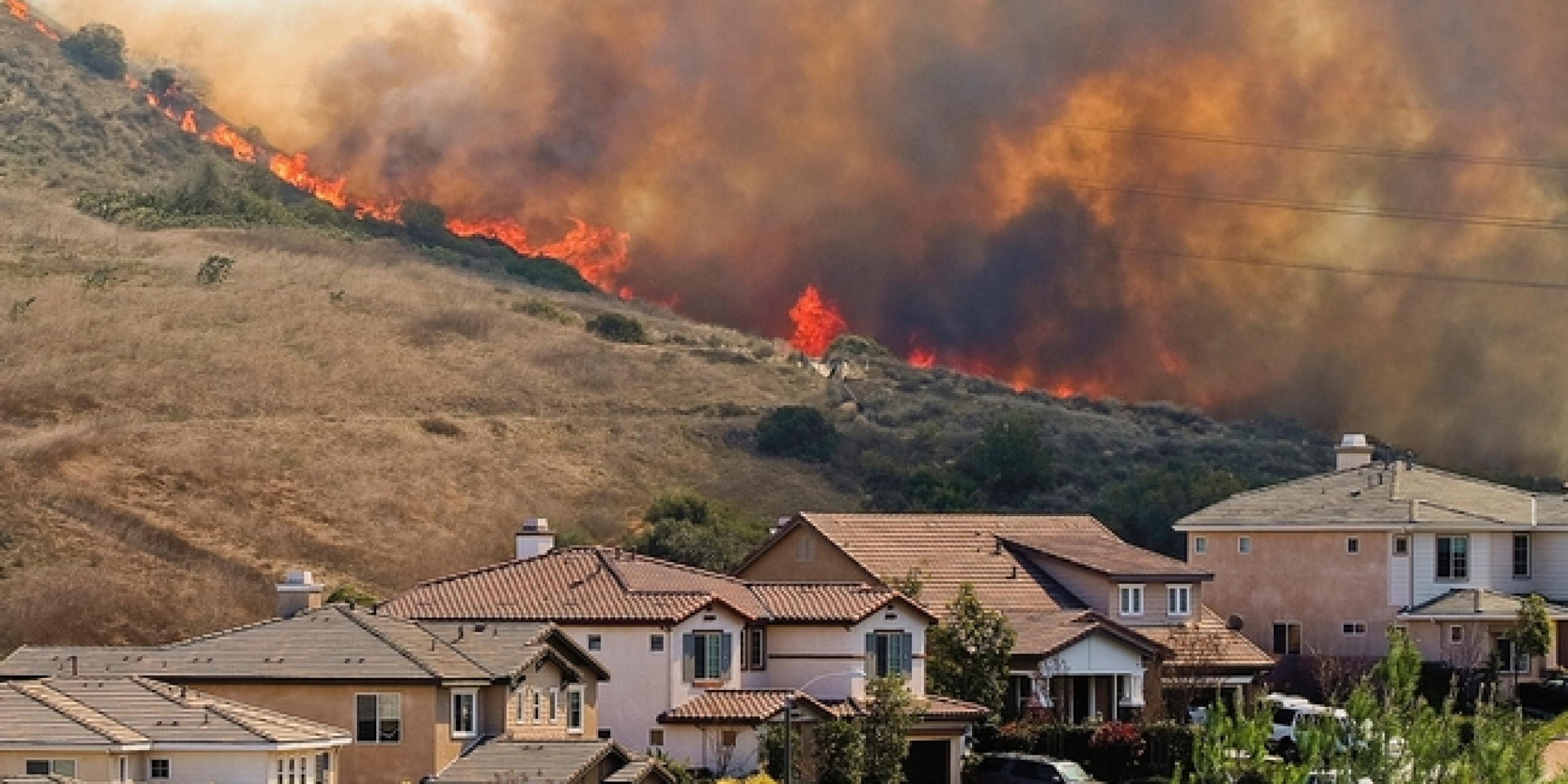
Fire at the wildland-urban interface. (Image: FEMA)
|
Impact statement: The nationwide inventory of emissions from structure fires lays the groundwork for communities to be more prepared for and resilient to the impacts of smoke from wildfires in urban areas. |
A research team led by the U.S. National Science Foundation National Center for Atmospheric Research (NSF NCAR) has published a foundational inventory of emissions produced by structures destroyed by fires in the wildland-urban interface (WUI).
Previously, researchers suspected that fires in WUI areas – spaces where human development and undeveloped wildland meet – produce emissions that are likely more harmful than those produced by forest or grass fires. However, the amount of emissions had not been quantified.
This new study, published in Nature Communications, provides the first inventory of emissions from structure fires in WUI areas. The results definitively reveal structure fires as a major source of air pollution.
WUI fires are becoming increasingly more common in the U.S. and have destroyed more than 100,000 homes since 2005. Because these events are intensely concentrated both in time and space, they can produce exceptionally high local pollution, which has important implications for the air quality and public health of nearby urban areas.
“I didn’t expect emissions for some pollutants to be as high as they were, since the area burned is so small compared with vegetation fires,” said NSF NCAR scientist Wenfu Tang, the lead author of the paper. “But if you think about what’s in a home or office, there are many things that could be harmful to humans if ignited. For example, if you burn a smart phone, you wouldn’t want to inhale the gas.”
The research was primarily funded by NOAA’s Atmospheric Chemistry, Carbon Cycle and Climate Program.
Vegetation fires are more widely studied than WUI fires, largely because they are the dominant type of wildfire globally. However, researchers like Tang and her colleagues wondered if emissions from WUI fires have an outsized impact due to their proximity to communities and the type of fuel being burned. Because air pollutants from structure burning in WUI fires have not been included in national estimates of emissions, the team needed to devise a method for creating an inventory.
Quantifying fire emissions requires three key pieces of information: where the fire occurred, how much fuel was burned, and what pollutants were emitted from the fuel. Obtaining all of this information for structure fires has only recently become possible thanks to a new, user-friendly dataset created by researchers at the University of Colorado Boulder, who mined the U.S. National Incident Management System for information on wildfire events. This has made it much easier to determine the location and scope of WUI fires and how many structures were affected.
The team used the dataset to identify the scope of the area affected by WUI fires in the U.S. and how many structures were destroyed between 2000 to 2020. With that information, the team then cross-referenced the number of structures affected with a dataset called COMBUST that estimates urban fuels across the U.S to calculate what was burned in each fire.
With the numbers from those two datasets, it was possible for the researchers to calculate the emissions based on the mass of burned materials and estimated type of fuel. The researchers used median values of emission factors for pollutants from a previous study for this calculation. Using this middle value means exact pollutants could be more or less harmful in any given location.
“Assuming the same emission factor for all structures across the country means there is some uncertainty in the numbers,” said Tang. “We hope future studies will further refine these numbers, but even this baseline inventory of emissions is important for understanding the impact these fires have on communities.”
The team confirmed that wildfires that burn structures emit a more complex mix of hazardous pollutants due to the combustion of materials such as plastics, treated wood, wiring, and other household items. The emissions included pollutants ranging from carbon monoxide to hydrochloric acid and lead. The types of emissions coming from buildings being burned in WUI fires are harmful to human health. Beyond influencing local air quality, researchers suspect the pollutants could also infiltrate homes downwind from evacuation areas affecting more than those inside the burn zone.
The research also revealed that the 20 most destructive fires accounted for 68% of carbon monoxide emissions from WUI fires. In several states, emissions of specific hazardous pollutants exceeded those from all of the anthropogenic emissions combined. The concentrated impact of a few extreme events highlights the importance of improving our ability to forecast WUI fires and model their emissions, the researchers said.
“The growing frequency of large structure fires, especially across the Western U.S. emphasizes the need for greater understanding about these fires and their effects on people,” said Christine Wiedinmyer, director of UCAR Community Programs and second author of the paper. “We need more research on these types of fires in order to make our communities safer.”