
Gathering rare airborne observations of firestorm clouds
The NSF NCAR Gulfstream V helps unravel the mysteries of pyrocumulonimbus storms
Oct 14, 2026 - by David Hosansky
Oct 14, 2026 - by David Hosansky
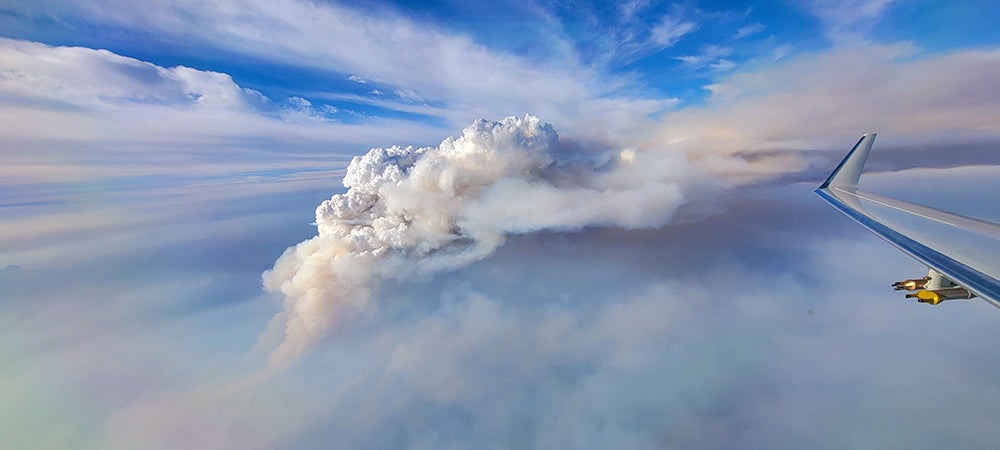
The NSF NCAR Gulfstream V took up-close observations of a pyrocumulonimbus cloud that was fueled by the Border 2 wildfire in Washington State and British Columbia. (Photo by Chris Kruse, NSF NCAR.)
| Impact statement: NSF NCAR collaborated with NASA and the U.S. Naval Research Laboratory for a field campaign gathering unprecedented data about powerful pyrocumulonimbus storms that are fueled by wildfires. |
Just minutes into a planned research flight from Colorado to Oregon in August to study massive storm clouds fueled by intense wildfires, scientists discovered that a fire in Utah actually offered a more promising target. The mission support staff on the ground scrambled to draw up a new flight plan, and the pilots of the U.S. National Science Foundation National Center for Atmospheric Research (NSF NCAR) Gulfstream V worked to get the green light from air traffic controllers to fly toward the wildfire-generated thunderstorm.
This was the type of agile maneuvering that enabled scientists on a major field campaign this summer to take unprecedented observations of powerful pyrocumulonimbus or "firestorm" clouds. Such clouds are notorious for producing hazardous weather, including dry lightning strikes, strong downbursts of wind, and fire tornadoes, along with dense smoke plumes that can rise to the cruising altitudes of aircraft and rapidly move across North America.
The major field campaign, known as INSPYRE (which stands for INjected Smoke and PYRocumulonimbus Experiment), is a collaborative effort by NASA; the Naval Research Laboratory; the University of Nevada, Reno; and NSF NCAR; among other partner organizations. Deploying two aircraft as well as ground instruments, the research team gathered a remarkably rich trove of data about the properties and chemical composition of the clouds and their behavior in the atmosphere.
Scientists expect the data collected during INSPYRE will lead to new insights into pyrocumulonimbus, which are one of the least understood forms of severe weather on Earth. This can improve weather forecasting, aid firefighting efforts, and potentially give aircraft more information about avoiding turbulence and other hazards when flying near major fires.
INSPYRE is scheduled to span five years, with another field deployment in 2027 followed by three years of scientific analysis and publication. It is funded through NASA’s Earth Ventures program.
“This first INSPYRE deployment gave us an unprecedented opportunity to observe fire-generated storms from multiple perspectives and at multiple stages of their development,” said David Peterson, research meteorologist at the U.S. Naval Research Laboratory and principal investigator for INSPYRE. “The NSF NCAR Gulfstream V was a critical part of that effort, allowing us to directly sample smoke and the environment surrounding these storms while our other observing systems looked at them from above and from the ground. We now have an extraordinary dataset that will help us better understand why some wildfires generate these powerful storms, how they transport smoke into the upper atmosphere, and ultimately how we can improve our ability to predict their impacts.”
Pyrocumulonimbus storms form when intense wildfires generate towering thunderstorm clouds capable of producing lightning, tornado-like fire whirls, erratic winds and massive smoke plumes that rise as high as the stratosphere. These storms can whip up flames through powerful gusts and also ignite new fires through lightning strikes, creating a dangerous self-sustaining cycle that remains poorly understood and extraordinarily difficult to predict.
“Being able to predict when a fire is going to have enough energy in the right atmospheric environment to create these clouds is very challenging,” said NSF NCAR scientist Teresa Campos, who used two instruments called spectrometers on the GV aircraft to measure concentrations of several gases. “There’s so much we don’t know about pyrocumulonimbus clouds, and we need to learn more both because of their impacts as they form over the fires and also because these densely polluted air parcels are very long lived, moving around the Earth and influencing weather and atmospheric properties for thousands of miles downwind.”
To learn more about the storms, scientists deployed two aircraft: NASA’s high-altitude Earth Resources-2 (ER-2) aircraft based in Great Falls, Montana, and the NSF NCAR Gulfstream V (GV) based in Broomfield, Colorado. While the ER-2 carried remote sensors high above the fires, the GV flew into the plumes and clouds with specialized instruments that measured gases, particles, and atmospheric motions.
“INSPYRE shows the extent to which collaborations can advance our understanding of the atmosphere and how it affects us, especially with the coordinated flights between NSF NCAR and NASA,” said NSF NCAR’s Cory Wolff, the project manager of INSPYRE. “It’s a real testament to collaboration.”
The field campaign required carefully coordinated efforts between those on the ground and in the air in order for the GV to sample all stages of pyroconvection over active wildfires as well as smoke plumes that had reached high in the atmosphere from minutes to days before the measurements were taken.
“One of the things people may not realize about an INSPYRE flight is just how much teamwork is involved,” said NSF NCAR pilot Bo LeMay. “We may have more than 30 people on the ground analyzing weather, satellite imagery, fire behavior, and other data and providing real-time information and recommendations to the mission scientists onboard. The mission coordinator onboard provides another set of eyes, with access to the aircraft’s scientific instrumentation, our weather radar display, NEXRAD, and satellite information. Ultimately, the pilot in command makes the final decision about where we fly, but we’re all sitting in the same airplane and working toward the same goal: collecting the best science possible while operating the aircraft safely.”
Tracking down pyrocumulonimbus is challenging because it involves predicting both wildfire activity and atmospheric conditions. But the research team scored repeated successes in its efforts to target the storm clouds across the West. The GV even took an unexpected flight to Alaska to study a large smoke plume that had been injected into the atmosphere by pyrocumulonimbus in Siberia and was studied by the aircraft for three days as it moved across the United States, affecting the atmosphere for thousands of miles downwind.
Sarah Woods, an NSF NCAR mission coordinator, served as a spotter on about half of the GV’s 17 INSPYRE flights. When the aircraft swung out ahead of the fires, she could get a visual of the pyrocumulonimbus and guide the pilots toward the correct storm clouds.
“It was helpful to have someone up front to quickly point over the pilot’s shoulder to identify which clouds we wanted to sample and guide them to where and how we wanted to sample them,” Woods said. “You can get convective clouds just growing generally in the area, but we wanted to make sure we were finding the clouds that were actually produced by the fire. I looked for the flames and smoke plumes on the ground and then for the visual connection showing that the smoke was actually feeding into the convection being driven by the fire.”
Flying into the firestorms was a surreal experience, the scientists said. The storms were dark with an orange hue, and it was possible to smell wildfire smoke on board the aircraft.
Woods and other mission coordinators served as liaisons between the pilots and scientists. They drew on their meteorological and aviation knowledge to help identify regions in which scientists could collect needed data while understanding how the pilots would steer clear of especially turbulent regions.
“The forecasting challenge was extremely difficult,” said NSF NCAR’s Chris Kruse, who also served as mission coordinator on several of the flights. “We had to be constantly flexible with our targets.”
“To literally on the fly completely change your flight plan and your sampling strategy and go after something else — I think that’s a great accomplishment,” he added. “I think that should be celebrated.”