
Identifying severe weather hazards further in the future with AI
Experimental forecasts leverage strengths of AI weather models to extend the forecast
May 4, 2026 - by Laura Snider
May 4, 2026 - by Laura Snider
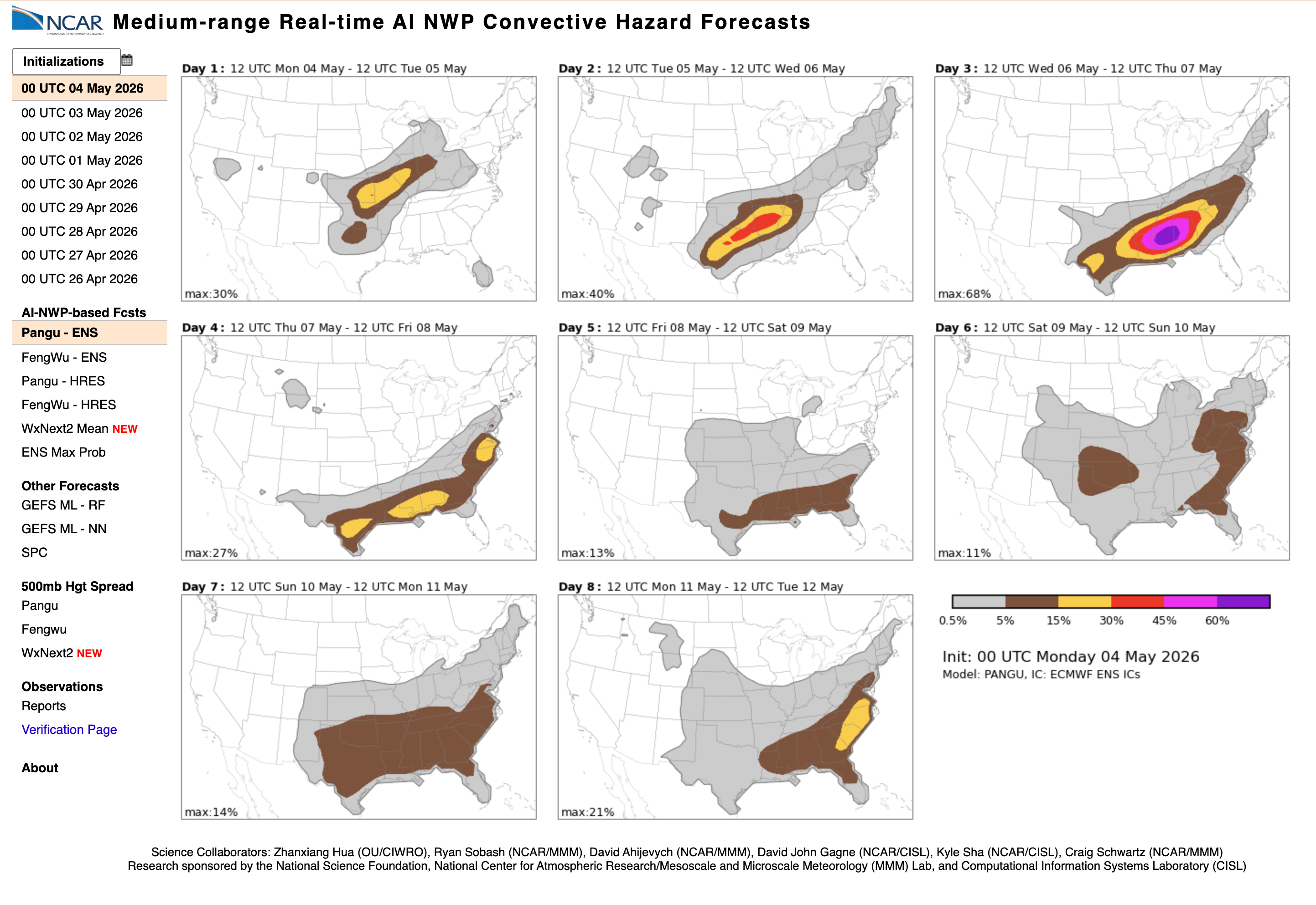
A forecast from NSF NCAR's Medium-Range Real-Time Convective Hazard Forecasting system shows a significant risk of hail, tornadoes, or other severe storm hazards in the Southeast on Wednesday, May 6, 2026.
| Impact Statement: Hail, tornadoes, and damaging winds associated with severe thunderstorms are especially difficult to predict, particularly at longer lead times. A new tool built at NSF NCAR takes advantage of the fact that AI weather models tend to have a better handle on large-scale weather patterns in order to help forecasters better predict damaging weather up to a week in advance. |
An artificial intelligence (AI) tool built by the U.S. National Science Foundation National Center for Atmospheric Research (NSF NCAR) can help forecasters look further into the future as they work to identify the potential for deadly severe weather outbreaks.
NSF NCAR’s Medium-Range, Real-Time Convective Hazard Forecasts leverage AI weather models — which tend to out-perform traditional models in the three- to eight-day time horizon — with the goal of improving our ability to predict the potential for tornadoes, large hail, and damaging winds a full week in advance.
The experimental forecasts, which are run daily and made available online, will be evaluated over the coming weeks at NOAA’s Hazardous Weather Testbed as part of the Spring Experiment. This annual program tests the utility of emerging scientific tools for front-line forecasters during an especially active season for severe weather. NSF NCAR’s convective hazard prediction system is one of several recent efforts by NSF NCAR scientists to explore how a range of AI tools and strategies could be used to help forecasters more accurately predict dangerous storm-related hazards at longer lead times.
“This work is part of a paradigm shift in how we model severe weather hazards,” said Ryan Sobash, one of the lead researchers on the project. “AI is allowing us to approach this problem in an entirely new way and to make progress on a forecasting problem that’s been difficult to overcome.”
A paper describing the forecasting system was published in Artificial Intelligence for the Earth Systems, a journal of the American Meteorological Society. The study was led by Zhanxiang Hua, a doctoral student at the University of Washington. The work was funded by NSF.
Using AI to fill forecast gaps
Forecasting when and where tornadoes, large hail, or damaging winds associated with severe storms will strike is a challenge. In part, that’s because these phenomena are too small to be captured by traditional weather models. Even the high-resolution models most suited for severe weather prediction cannot simulate an individual tornado — much less an individual hailstone — but they can simulate the larger storms that produce these hazards. Forecasters routinely analyze the output from these high-resolution models in search of the storm characteristics they know are associated with tornadoes, hail, and damaging winds.
While this model output is incredibly valuable, it does not translate directly into a probability that severe storm hazards will occur. Years ago, NSF NCAR scientists saw an opportunity to use AI to fill this gap. They trained a neural network to search for patterns in the storms simulated by the high-resolution weather models and compute a percent chance that tornadoes, hail, or damaging winds would occur at any given location in the next 48 hours. They made these forecasts available online beginning in the spring of 2020, and they are now being used frequently by some National Weather Service forecasters and have been included in training for NWS forecasters on AI tools.
The research team has continued experimenting with other ways to use AI to improve forecasts of severe storm hazards. For the more recent Medium-Range, Real-Time Convective Hazard Forecasts, the researchers have taken traditional weather modeling out of the equation altogether.
Extending the forecast
Rather than using AI to post-process output from traditional high-resolution weather models, as in their earlier project, the new project relies on output from AI weather models that emulate traditional models. These emulators, which have proliferated in the last couple of years, can approach and even out-perform the skill of traditional models, and they do so using a small fraction of the computing power necessary to run a traditional high-resolution model. This saves time as well as energy.
“We can run a forecast in a matter of minutes,” Sobash said. “The same forecast would take many hours to run with a traditional model.”
As in the earlier work, researchers use an AI algorithm to post-process the simulations — but in this case they use simulations from AI emulators instead of traditional models — to come up with a percent likelihood of severe weather hazards.
The new project also differs from previous work in another important way: It provides forecasts much farther in advance. This is possible because AI weather models can be more accurate than traditional models at longer time horizons.
“One of the biggest differences we see between AI models and traditional models is in the range of three to seven days,” Sobash said. “The AI models seem to have a better handle on the large-scale patterns in that window, and while they don’t have information on individual storms, they can give forecasters an idea of whether conditions are setting up to favor severe weather.”
Accordingly, the new forecasts do not provide probabilities that a particular hazard — tornadoes, large hail, or damaging winds — will occur, just the probability that some type of severe weather hazard could happen.
“What’s really fascinating is that our AI system can still predict severe weather without certain traditional severe weather 'ingredients' that forecasters usually look for,” Hua said. “The AI is smart enough to recognize the hidden, complex patterns leading to dangerous storms just by looking at basic weather variables. It highlights just how powerful AI is at connecting the dots to forecast severe weather events.”
The earlier forecasts released in 2020 do provide probabilities for individual types of hazards, though they only go 48 hours into the future. While the new forecasts do not delineate which specific hazards may threaten a community in the coming week, they still provide vulnerable residents with more lead time to plan for dangerous weather. As a next step, the research team is working on adding individual hazard probabilities to the longer-term forecasts as well.
"Looking ahead, we are excited to push these boundaries even further," Hua said. "Our next steps involve combining, or fusing, multiple different AI and traditional weather models together to create an even more accurate, robust forecast. We are also working on extending our severe weather predictions all the way out to two weeks in advance, giving communities even more time to prepare."
While the new forecasts are a promising application of AI weather models, they don’t negate the need for traditional, high-resolution weather modeling. In fact, the output from traditional models provides the data that’s necessary to train and verify AI models. And traditional weather models, which are built using equations that reflect our understanding of atmospheric physics, are critical tools for deepening our knowledge of the physical processes that cause severe weather hazards.
“AI does not replace traditional models, but it can help us get more useful information in addition to those models,” Sobash said. “It’s really an exciting time to be working on improving historically challenging severe weather forecasts.”